
The article below was written by Houssein Rayaleh, a Djiboutian field biologist with Conservation Allies’ new partner, Association Djibouti Nature. In 2019, Houssein led the expedition that rediscovered the Somali sengi after more than fifty years out of sight of international science, and he is co-author of the PeerJ paper that introduced the species to the world under its new genus name, Galegeeska. What follows is his account, in his own words.
For more than fifty years, the Somali sengi—a tiny mouse-sized creature with a long, curious nose, closer in kinship to elephants than to shrews—was thought lost to the world. Yet in Djibouti, and across the wider Horn of Africa where Somali communities live, it was never forgotten. Known as wali sandheer or walo sandheer, “the one with the long nose,” it lived in the whispers of nomadic tales, a shadow in the memory of communities who always knew it was there.
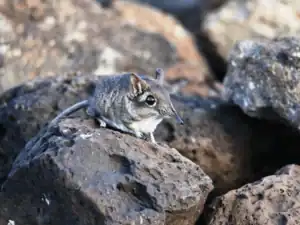
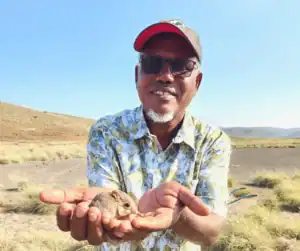
Then, in 2019, hope took form. A collaborative field expedition between Djiboutian wildlife specialists from Association Djibouti Nature and American sengi experts from the Duke Lemur Center and the California Academy of Sciences was coordinated. My colleagues, Steven and Galen, thought it would be difficult to locate the sengis in Djibouti. But since I (Houssein Rayaleh, Field Biologist at Association Djibouti Nature) knew that sengis lived in Djibouti, particularly in the Djalelo Protected Area in the Arta region, I was confident in our first target site for trapping. On the very first night in the field one of our traps revealed what the world thought it had lost: the Somali sengi, alive and resilient. DNA studies later confirmed that it belongs to a new genus, Galegeeska—a name that refers to the Horn of Africa, where the species is endemic, and that also honors the late Galen Rathbun, the world’s foremost sengi expert. Rathbun, who was part of the team that rediscovered the species in Djibouti, passed away only a few months before the publication of the PeerJ paper on the Somali sengi.
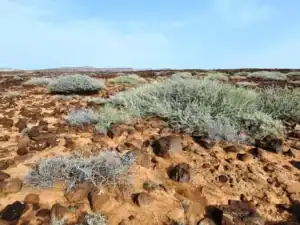
The Somali sengi (Galegeeska revoilii) was first described in northern Somalia—today’s so-called Somaliland—and was long thought by the international scientific community to be restricted to that region, until its rediscovery in Djibouti in 2019 expanded its known distribution range. I had regularly encountered the Somali sengi, but I was unaware of its conservation status and taxonomy, or that the international scientific community had lost sight of it.
With this rediscovery, Djibouti shone brightly on the global map of biodiversity. But this was more than science. It was a story of pride, of resilience, of ancestral knowledge meeting modern discovery. While the world had written the sengi off as extinct, Somali communities in Djibouti, Somalia, Ethiopia, and Kenya carried its memory like a flame. Its return reminds us that nature still holds secrets, waiting for those who care enough to listen.
The few known natural habitats of the Somali sengi in Djibouti are increasingly under pressure from activities such as the extraction of construction materials, including basalt rubble that may serve as shelters for the species; electricity line development projects, where construction work disrupts and destroys many of its shelters; the concentration of nomadic herds and their livestock around its known distribution sites, as secondary villages attract more former pastoralists; and climate-driven degradation, including recurrent and intensifying droughts, which cause permanent disturbances linked to the movement of herders in search of grazing lands.
Without such measures, emerging threats such as the expansion of development infrastructure, quarrying, overgrazing, climate change, and predation by domestic animals—particularly feral cats associated with the growth of new villages and human settlements within the species’ known range—will continue to threaten the survival of sengi. These settlements generate domestic waste and introduce domestic cats that may breed with wild cats, producing hybrid cats that invade habitats and could further compromise the fragile survival of the Somali sengi.
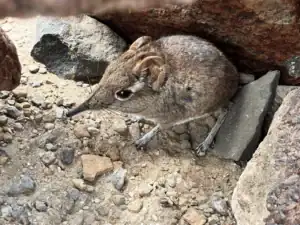
Although the species is still listed as Data Deficient on the IUCN Red List, experts from the IUCN Species Survival Commission Afrotheria Specialist Group recommend reassessment to better reflect its true vulnerability.
To ensure this rediscovery becomes a lasting survival story, three actions are essential: urgent field surveys across all potential natural habitats to assess population size, distribution, and status; comprehensive threat assessments; and awareness-raising campaigns targeting communities, government agencies, civil society organizations, and conservation partners.
And the story does not end there. In 2023, the cheetah—absent for more than thirty years—was once again confirmed in Djibouti. That same year, the elegant lesser kudu was also documented for the first time in the nation’s natural history. Each rediscovery is a heartbeat, proof that Djibouti is not a barren land defined by military bases, but a sanctuary of hidden wonders.
Association Djibouti Nature, modest in resources yet rich in dedication, has carried these treasures into the light. With greater support, more secrets can be unveiled, more species safeguarded, more pride restored. The Somali sengi, the cheetah, the lesser kudu—they are not just animals. They are symbols of resilience, of hope, of the fragile beauty that binds us to the earth.