
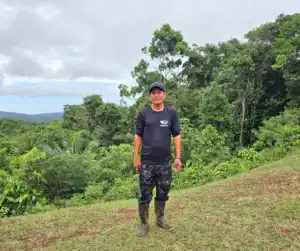
Luis Alberto Pérez Martínez—Don Luis, as he’s known locally—has spent years learning the trails of Sierra Llorona. As a park ranger in Colón province, Panama, he knows every trail, every canopy gap, every sound the forest makes. So when the sound changed one February morning—engines and chainsaws where there should have been birdsong—he knew something was wrong.
“The first thing I saw was a crew cutting down trees,” he recounts. The workers claimed to be government personnel sent to begin road construction through the forest. Don Luis acted quickly: he photographed the site, recorded GPS coordinates, and contacted Guido Berguido, Executive Director of Conservation Allies partner ADOPTA. The engineer ordered the logging to stop—but the next day, the crews returned.
With Guido’s backing, Don Luis took the case to Panama City. A month later, ADOPTA mounted a protest at the site that stretched nearly two weeks and held firm until a court temporarily suspended the project.
Why Sierra Llorona Matters
Sierra Llorona is no ordinary forest. Nestled between the Panama Canal and the Atlantic slope of Colón province, its ancient primary rainforest shelters Jaguars, Harpy eagles, Baird’s tapirs, and the Critically Endangered Limosa harlequin frog. It also forms a critical link in the Mesoamerican Biodiversity Corridor, connecting Panama’s Soberanía and Chagres national parks and serving as a vital passage for wildlife moving across the region.
The road in question is the Caribbean Corridor—a $91 million highway planned to run 17.6 miles along the Colón coast, with the stated goal of boosting tourism and local commerce. Road construction threatens Sierra Llorona not only through direct habitat loss, but by opening the forest to illegal hunting, logging, gold prospecting, and invasive species. Panama law requires a full Environmental Impact Assessment for projects of this scale—but the highway was deliberately divided into multiple sections, each evaluated separately, which critics argued was designed to make the project’s impacts appear more moderate than they actually were when considered as a whole.
A Hard-Won Victory
The court suspension that ADOPTA’s protest helped force didn’t cancel the construction of the road, but it did create the opening for something larger. With the project under legal scrutiny and public attention focused on the region, ADOPTA has been working with Panama’s Ministry of Environment to make the case that the existing Protected Area is far too small to withstand the pressures a new highway will bring—and conversations about significantly expanding protections in the region are ongoing. For Don Luis, who raised the alarm alone on a trail that February morning, it is a hard-won start, and a reminder that acting quickly, even in the face of uncertainty, can change the course of what is protected and what is lost.