


It is also under sustained threat. Forest fires, illegal occupation, and land conversion have erased thousands of acres in recent years, and the conventional tools of conservation—patrols, prosecutions, fire response—can only go so far when the underlying economics push local people toward clearing the land rather than keeping it standing.
This year, that calculus shifted.
Conservation Allies’ partner, Defensores de la Naturaleza, which co-manages Sierra Lacandón alongside Guatemala’s National Council of Protected Areas, confirmed that more than 135,000 acres of the Park have been formally recognized under Guatemala’s Emissions Reduction Program and folded into the “Lacandón: Forests for Life” project. The recognition spans community agreements, state-owned areas, and private property—a structure deliberately designed to bring the full range of local landholders into a single conservation framework.
Translated into practical terms: forest protection now generates payments to the people doing the protecting.
What 135,000 Acres of Recognition Actually Means
To date, the program has paid 204 people inside the recognized area for their conservation work. 42% of them are women. Both numbers reflect a deliberate effort: pay the people closest to the forest, and make sure women are central to the model rather than peripheral to it.
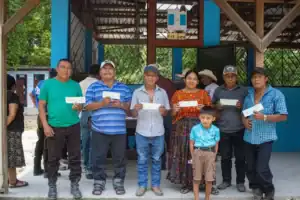
The financial structure of the community-based portion is built to reinforce that. 55% of resources go to conservation activities and community projects; the remaining 45% is distributed directly to community members involved in conservation.
Other areas of the park—not necessarily community-managed—were also recognized under the program, opening the door to new financial resources for management, protection, and rapid response in the years ahead.
The Wildfire Backstop
Recognition under an emissions program is meaningful only if the forest is still standing. That’s where Conservation Allies’ support has focused. In Sierra Lacandón, we’ve supported wildfire mitigation and patrol coordination across the park—the unglamorous, year-round work that prevents a single dry-season blaze from undoing years of community agreements and ecosystem recovery.
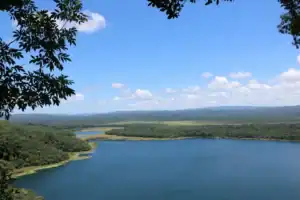
The combination is what makes the model functional. Fire prevention and law enforcement protect the asset. The Emissions Reduction Program pays for keeping it intact. Community participation ensures the people closest to the forest have a real stake in its survival.
A Model Worth Watching
Sierra Lacandón sits at the intersection of some of the hardest problems in conservation: vast scale, contested land, real poverty, and ecosystems that simply cannot be replaced. The breakthrough at the park isn’t that any one of these problems has been solved. It’s that a workable structure now exists for confronting them together.
For the Jaguars, macaws, and tapirs of the Maya Biosphere—and for the families now stewarding their habitat—this is what a future looks like.